ARESTAS
Solo show
Massapê Projetos
Curated by Juliana Monachesi
May 2nd, 2022 - May 6th, 2022
Politics of Edges
Arquitetura de Arestas is a book about politics. By chance, I leafed through the publication a few days after visiting the studio of Fabiana Preti, where we talked, among other aspects of her production, about the political stance implicit in choosing abstract painting as an aesthetic language. Because it is an abstraction that flirts with geometry while deliberately refusing some of its precepts, I left the studio thinking that the artist’s research constitutes a Painting of Edges. With these two sets of edges in mind, I began to speculate whether it would be possible to create an intersection between them—or even whether it might be necessary to radicalize toward an operation of difference or union. To refuse, to deliberate, to conjecture, to radicalize. Politics is a list of verbs. Naming is a political act. I decide to call this text Politics of Edges.
The vocabulary employed in Arquitetura de Arestas, although the work by the young intellectuals Edemilson Paraná and Gabriel Tupinambá focuses on “the left in times of the world’s peripheralization,” approaches the lexicon of forms mobilized by Preti in her recent series of large-format paintings. When the authors identify in the Brazilian left an anti-systemic critique with a distorted sense of proportion that ends up sacrificing the complexity of the real, I think of the artist’s critical use of a certain distortion of proportions to encompass the complex diversity of reality.
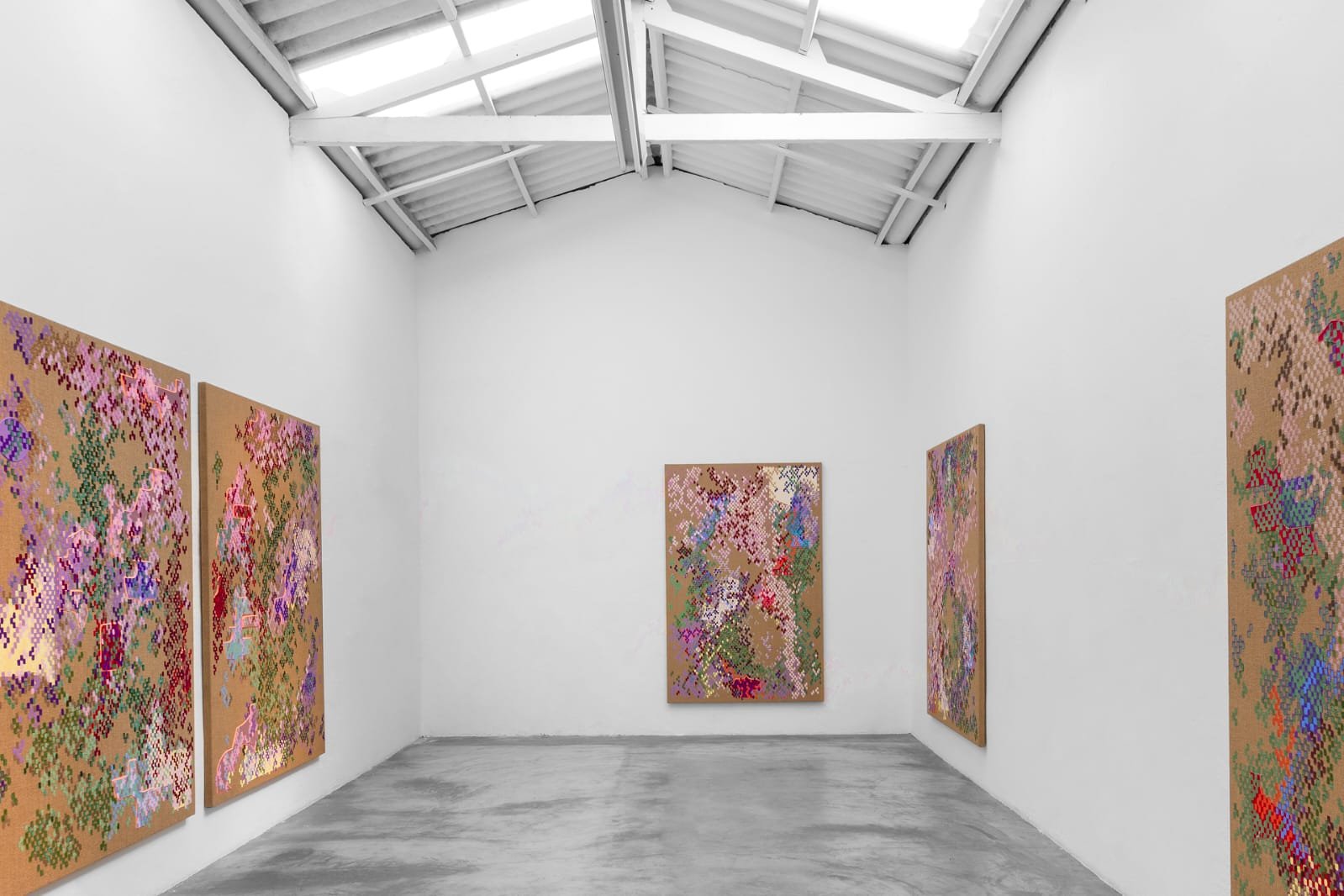
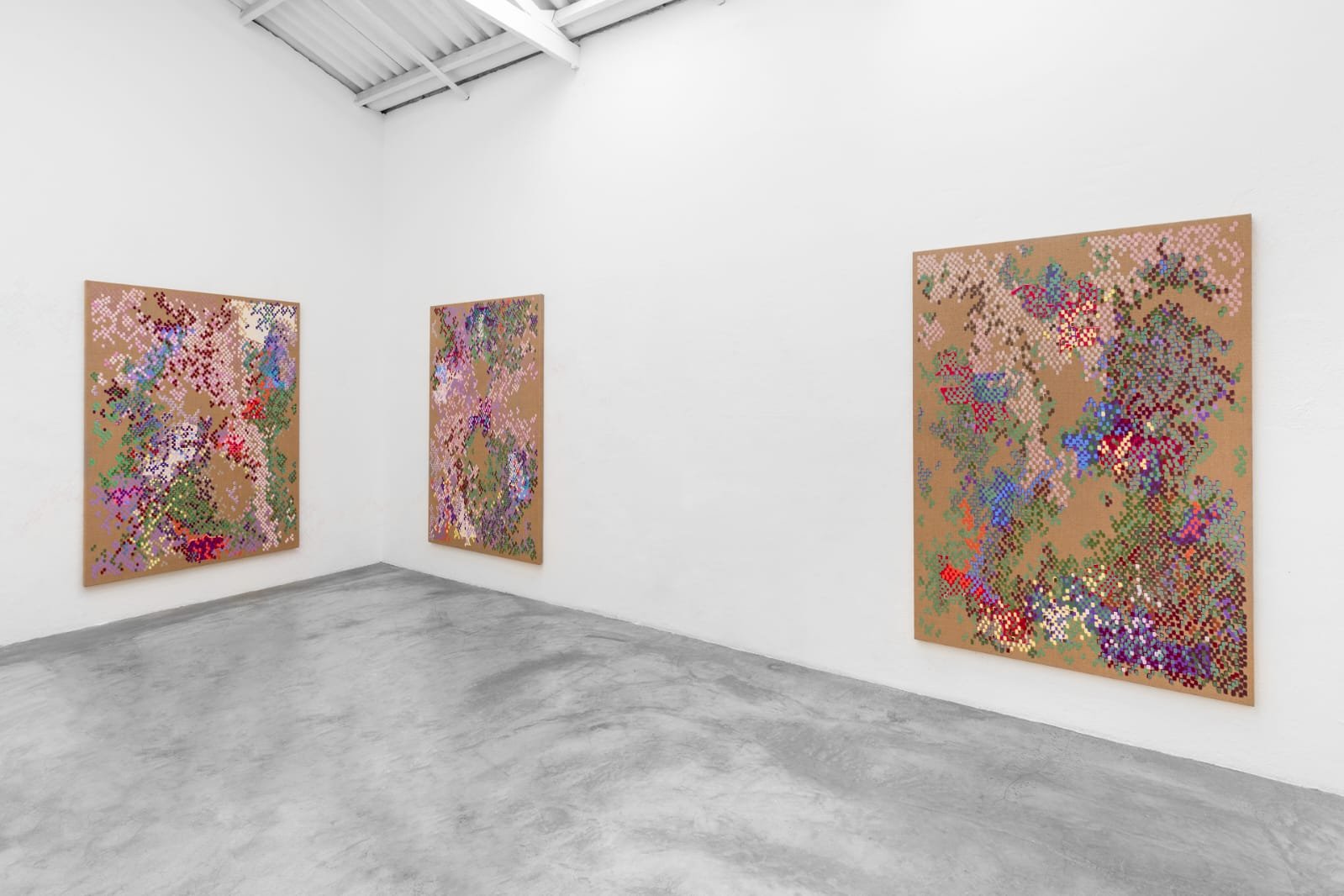
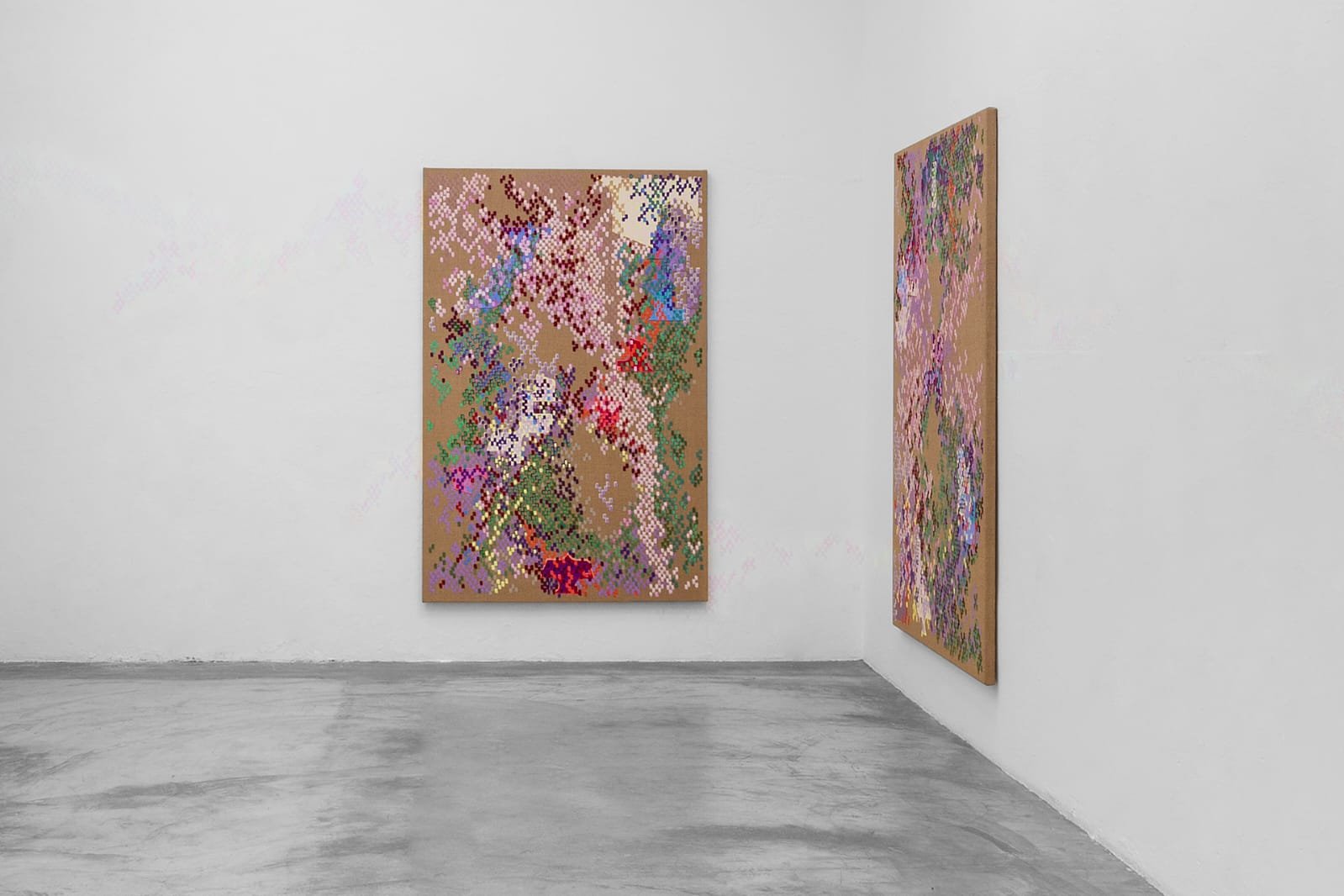
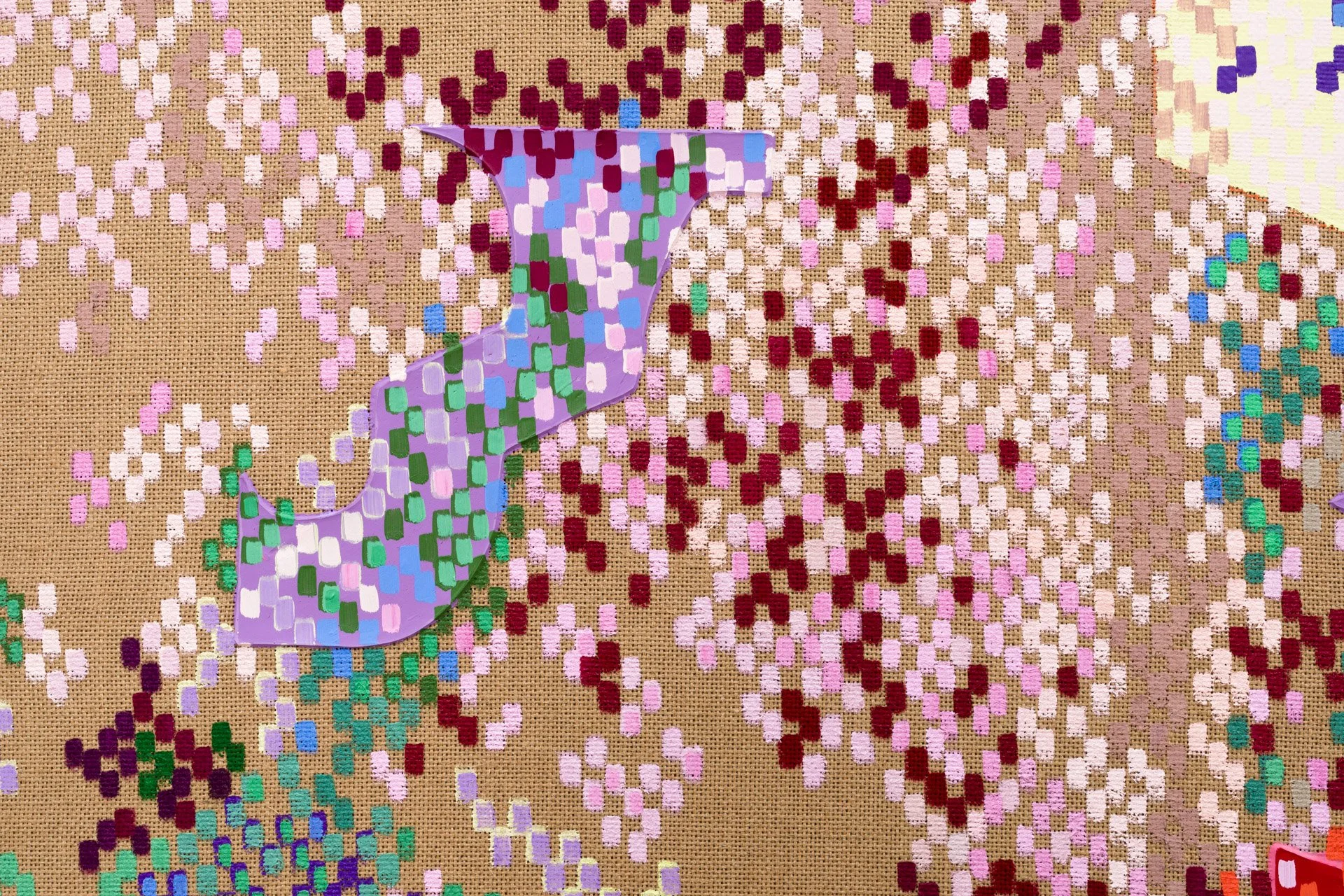
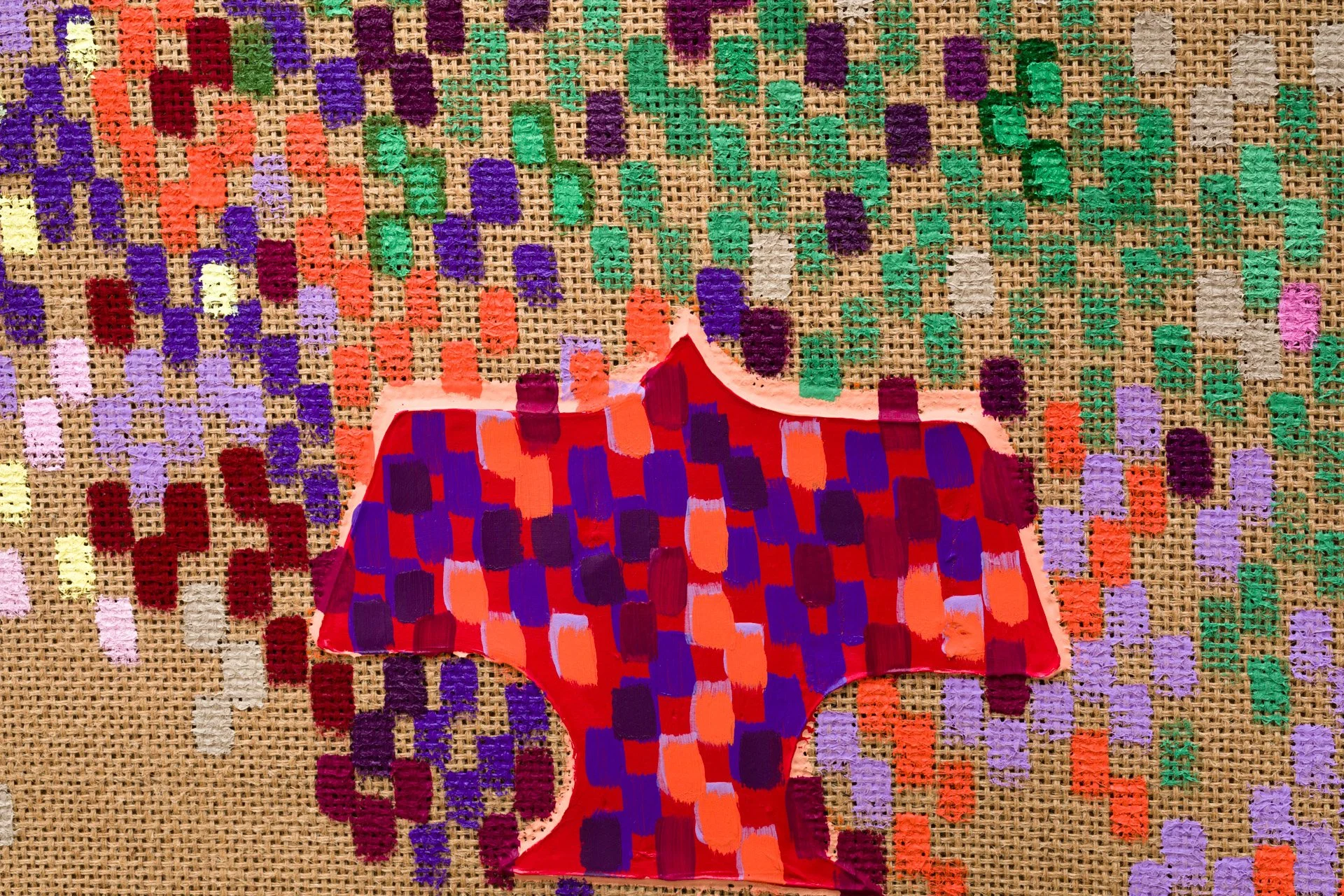
Likewise, when they diagnose the challenge posed by the flexible plasticity assumed by new forms of capital accumulation and exploitation in today’s world, what comes to mind is the grid system that the artist has refused to abandon since her works of 2016, the year she decided to become a full-time artist. The modulation of small geometric forms, organized according to a rhythm and an invisible structure (Preti does not use masking tape in the construction of her paintings: every straight line there—and there are many—is the result of an eye-hand articulation that would astonish any architect), creates a gravitational field that resists the plastic malleability of the larger, thicker forms, applied using stencils she cuts herself (by hand, of course).
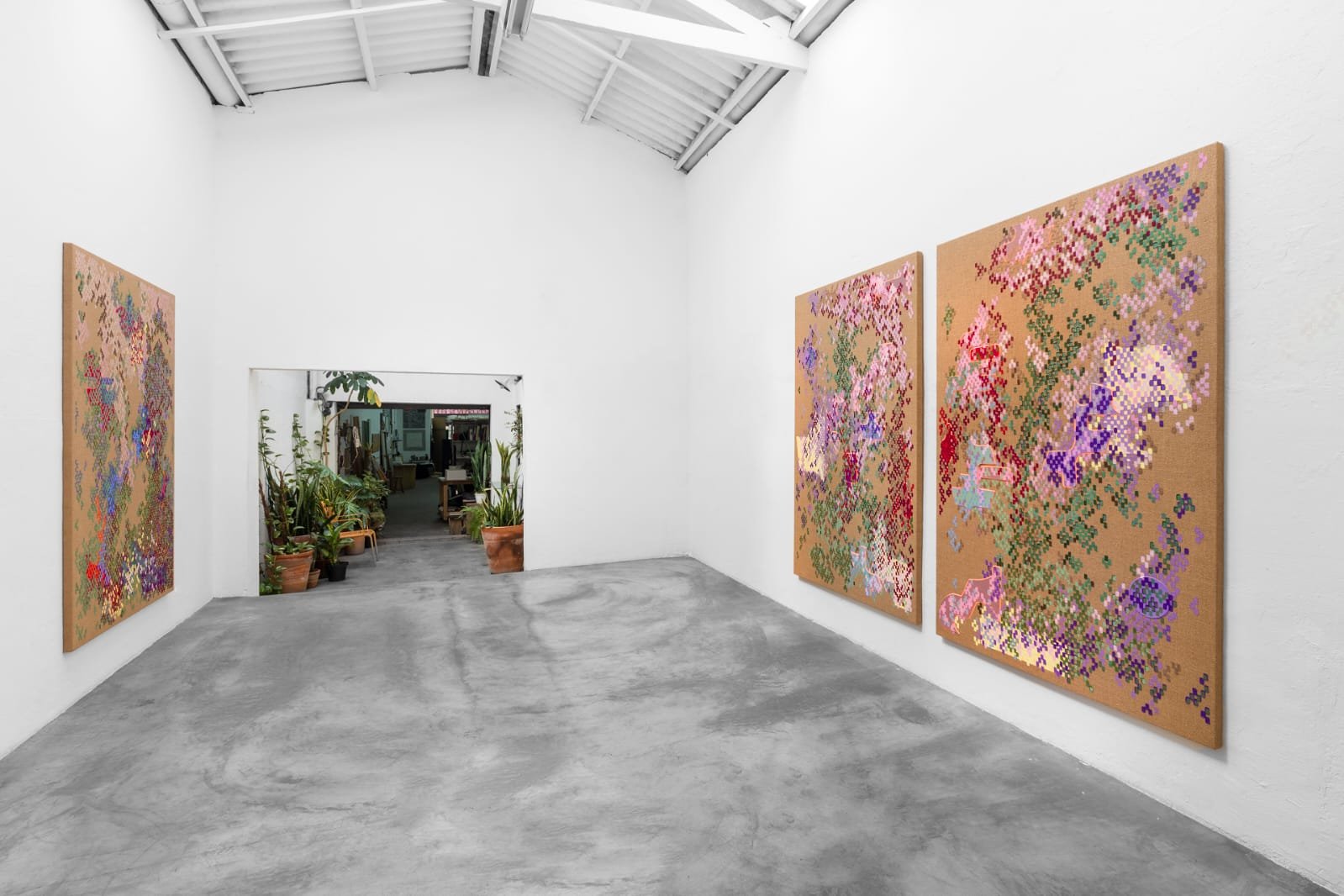
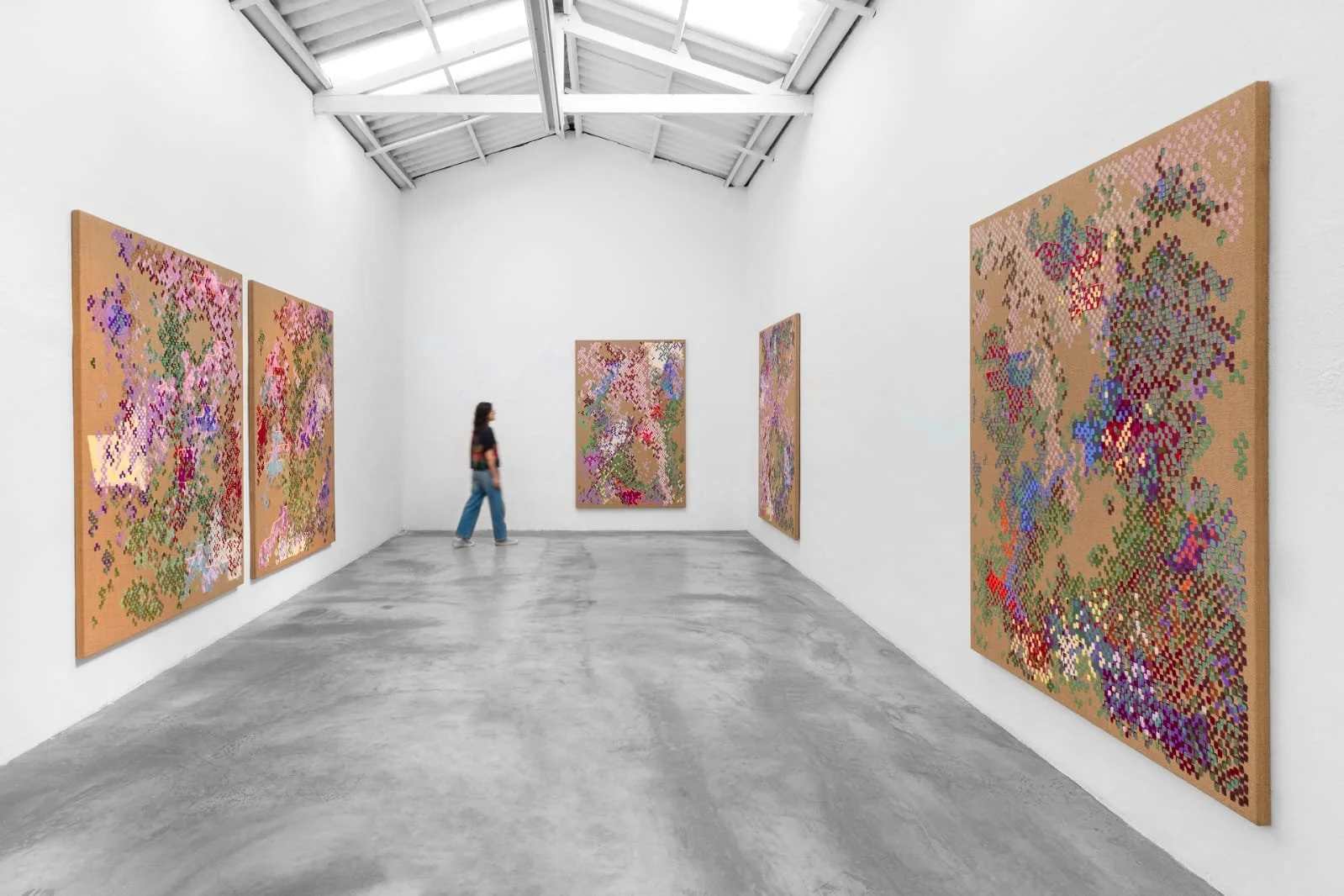
Each of the five canvases made for the present exhibition is a field of forces installed before the viewer, to be scrutinized at medium and long distances. The movement of the body makes it possible to see, from afar, a harmonious, organized whole, where a kind of systemic rupture is at stake. Up close, however, the battlefield reveals imperfect fragments, calculated disorganization, and the edges that configure a sharper break. The closer the body gets to the canvas, the more radical Preti’s operation seems; yet, once pressed against the surface of jute partially covered in oil paint, any notion of the whole is lost.
This irresolvable oscillation, destined to repeat itself infinitely, is not unlike the paradox pointed out by Paraná and Tupinambá regarding attempts to civilize capital, which inevitably result in being colonized by it. The “concrete analysis of concrete reality,” in politics, leads to the aporias of the party-form. Here, a concrete analysis of the concrete materiality of these art objects—objects that gain political weight when understood as discourse-representations of the world—results in uncertainty about the formal stance defended by the artist.
To be an artist is to take sides. Choosing abstract language is a political attitude. What side do the forms that oscillate between orthogonal rationality and baroque gesture take in Preti’s works? Are these two pictorial repertoires being operated as intersection, difference, or union? And, more importantly, is it necessary to solve this equation? I return to the lexicon of Arquitetura de Arestas: in the ephemerality of transitory movements, in the distrust of reason, the left rises up against the fixity of structures and the subsumption of the part by the whole, seeking new grounds on which to think the problem of freedom.
Faced with the lexicon of the Painting of Edges, I see an artist who rises up against a horizontality and an autonomy emptied of material content in order to seek the eruption of another form of freedom. In her Politics of Edges, the valorization of experience—materialized in the superimposition of layers that only partially camouflage the history of construction on the jute surface (even leaving the jute itself visible); the exercise of errors that disorganizes the modernist grid; the flow of creation that grants equal importance to all elements (both material and philosophical) in a generous and affective way; the artisanal meditation that contains, in potential, a vocation for urban scale and even a desire to intervene in public space, grounded in the sculptural imagination the artist carries with her (from her background in industrial design)—all this, finally, leads me to the provisional conclusion that the left has much to learn from edges.
Text by Juliana Monachesi (free translation)
Photos: Estúdio em Obra