
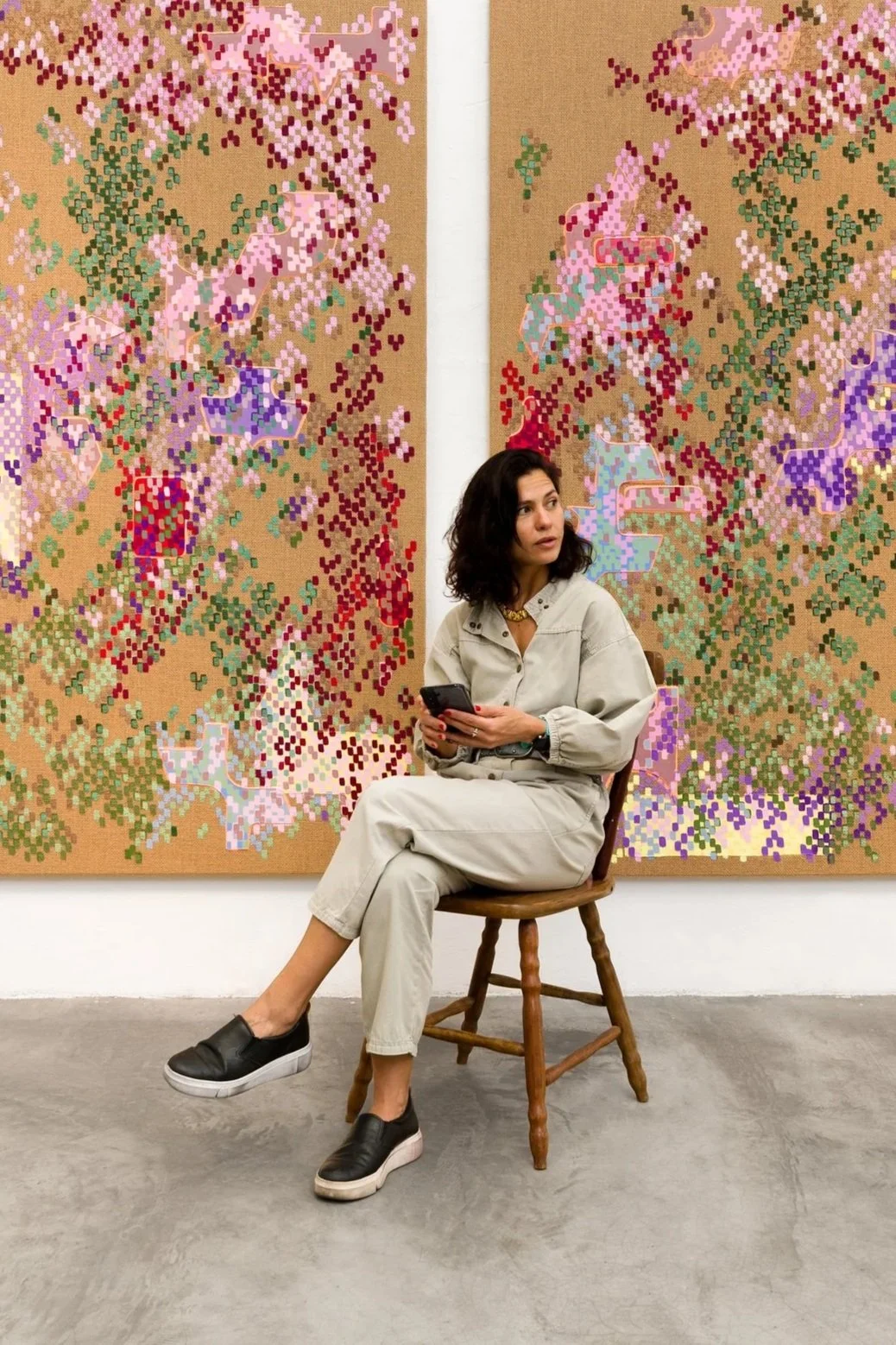
Fabiana Preti works in the interstices. Born and based in São Paulo, she investigates, across multiple languages, precisely the in-between spaces among the artifices of artistic creation. Holding a degree in industrial design from Fundação Armando Álvares Penteado, she echoes methods of precision and formal rigor in her production through gestural control. She began her research in the visual arts through tilework, unfolding relationships among forms, colors, and combinations in patterns painted on ceramic. Prelúdio is this starting point: the patterns, initially repeated on industrial objects, have served as the driving force of her production for more than ten years, and an interest in materiality has become increasingly present.
With a refined eye for the choice of materials and an attentive listening to what they have to say, her geometric compositions began to be applied to fabrics of various meshes and weaves—such as velvet, leather, jute, and traditional linen. The support and its porosity thus become the main protagonists in her research. Preti seems to trace the paths of materials and listen to what tonalities express and, in this exercise of absolute presence, the repetitive gesture unfolds across the languages she practices in a state of meditative trance. Beyond a formal procedure, it is in fact a way of being in the world, of thinking about time, gesture, the body, and space.
In this sense, repetition becomes an operation of resignification and transformation. Translating an inner temporality, points, lines, planes, and forms reiterate the creative impulse of a rhythmic logic; the elements function like scores that mark the tempo of her compositions. Thus, as in musical notation, the alternation between mark and silence is fundamental to the final work. As mentioned by Wassily Kandinsky, color has no limit in the representation we make of it when we hear the word; it is only in the relationships among tonalities, forms, and surface that melody takes shape. Emptiness in her works also constitutes matter—it is an active dimension that articulates the dynamic between cosmos and chaos that emerges in her practice.
This in-between space provides a framework for reading her production. Whether in painting and the relationships among form, color, and void; in embroidery between mesh and thread; or in sculpture and the play of scale between body and space, the symbolism Preti carries always refers to vital dynamics between balance and imbalance—what Buddhist practices call the middle path. Between materiality and spirituality, these trajectories and dialogues offer more compelling possibilities of drive than any egoic imposition.
Text by Gabriel Babolim
Solo Exhibitions
2026 | Reconvexo, Centro Municipal de Arte Hélio Oiticica, Rio de Janeiro. Text by Gabriel Babolim
2026 | Rumor’Rosa, Galeria Pilar, São Paulo. Text by Ana Avelar
2023 | Achego, Massapê Projetos, São Paulo. Text by Felipe Barros de Britto
2022 | Arapuca, Bomblô, São Paulo. Curated and with text by Theo Monteiro
2022 |Arestas, Massapê Projetos, São Paulo. Text by Juliana Monachesi
2020 | LuzAzuL, Galeria Thomas Baccaro, São Paulo. Text by Guilherme Teixeira
2019 | Ditongo, Massapê Projetos, São Paulo. Text by Danilo Oliveira
Group Exhibitions
2026 | Tudo aquilo que move, Frente, São Paulo. Curated by Ana Carolina Ralston
2026 | O Elã da Trama, Art Dialogues and Apartamento 61, São Paulo. Curated by Anita Goes, Mariane Beline e Iara Pimenta
2026 | Shape of Now, Saatchi Art. Digital exhibition. Curated by Erin Remington and India Balyejusa
2025 | Art > Cabinet, Art in Brackets, Brooklyn, New York
2025 | Fresta, Gruta, São Paulo. Curatorial follow-up by Thierry Freitas
2025 |Ambitude, Massapê Projetos, São Paulo. Text and curatorship by Ana Roman
2025 | Caleidoscópio, Castelinho do Flamengo, Rio de Janeiro. Curated by Francela Carrera with co-curatorship by Ana Carla Soler
2024 | Líquen Teso, Galatea, São Paulo. Text by Fernanda Morse
2021 | ........ seu poema, Massapê Projetos, São Paulo. Text and curatorship by Vivi Villanova
2019 | Istmo, Galeria Caribé, São Paulo
2019 | Tardes de Terça, Centro Histórico e Cultural Mackenzie, São Paulo
2019 | Vida, Instituto de Artes da UNESP, São Paulo. Curated by Lilian Bado
2018 | Canvas, Alphaville, São Paulo
2018 |Arte Formatto, Rua Colombia, São Paulo
2018 |Ocupação Studio Luiz Martins, Studio Luiz Martins, Barra Funda, São Paulo
Education
Bachelor’s Degree in Industrial Design – Fundação Armando Álvares Penteado (FAAP), 1998–2002
Courses and Project Mentorship
2026 | Artistic Guidance Group with Ana Paula Cohen and Thiago Honório
2024 | Reading and Writing, with Paloma Durante
2021–2023 | Discussion group on contemporary art with Germana Montmor
2019 | Laura Belém and Rafael Vogt Maia Rosa
2018 | Contemporary Art – Art History with Thiago Mesquita
2017–2018 | Paulo Pasta
2017–2018 | Regina Parra and Rodolpho Parigi
2017 | Art History with Rodrigo Naves
2016–2017 | Nino Cais and Carla Chaim at Hermes Artes Visuais