O ELÃ DA TRAMA
Collective show
Art Dialogues + Apartamento 61
Curated by Anita Goes, Mariane Beline and Iara Pimenta
May 07th, 2026 - May 23rd, 2026
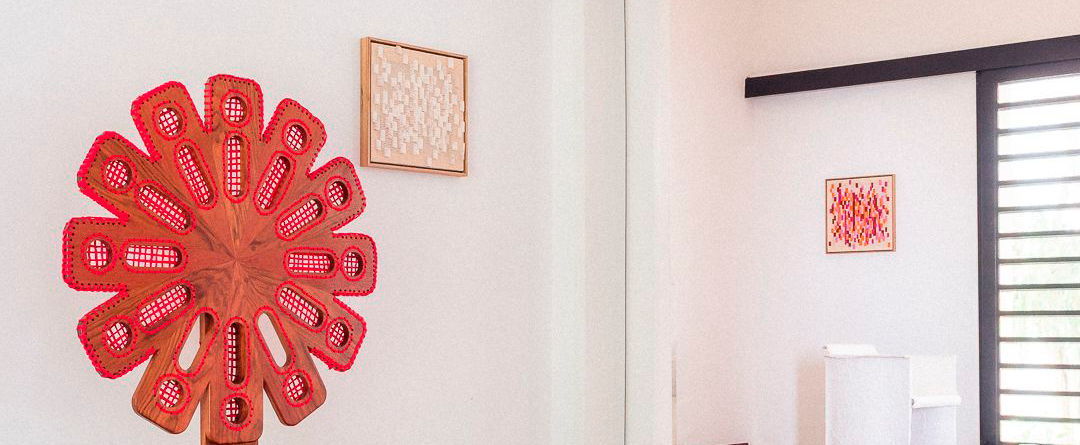
The exhibition o elã da trama celebrates the fifth edition of Art Dialogues magazine in partnership with Apartamento 61. Curated by Anita Goes, Mariane Beline, and Iara Pimenta, the group exhibition examines the relationship between textiles, the body, memory, and narrative through works by artists Alexandre dos Anjos, André Azevedo, Cícero Costa, Fabiana Preti, Luiz Escañuela, Gabriel Pessoto, Jala, and Paola Muller in collaboration with Taty Takasse. The artworks are accompanied by a design curatorship led by Vivian Lobato and André Visockis, focused on sustainability and cultural preservation, featuring pieces by Guilherme Wentz, Guá Arquitetura, Pirilampos do Planeta, Renata Meirelles, and Treivas Architecture Bureau.
Textiles have been fundamental to our lives since birth, connecting us to different times and places through material culture. Historically associated with the body and everyday life, fabrics shape our environments through objects and architectural elements. From this perspective, the exhibition considers how textiles reflect the human condition across cultures and evoke intimacy, care, and sensory experiences.
Spinning and weaving also illuminate narratives that traverse humanity and appear in mythology, such as the technical mastery of weaving by Arachne, which led her into a contest with Athena and culminated in the terrible punishment of her transformation into a spider, condemned to weave eternally. Another myth is that of Penelope, wife of Odysseus, who activates feminine strength by articulating time through the loom, cleverly conditioning her destiny to the act of weaving. By weaving during the day and unraveling at night, Penelope sustains time through her active gesture — a powerful action that can be perceived in each of the artists featured in the exhibition.
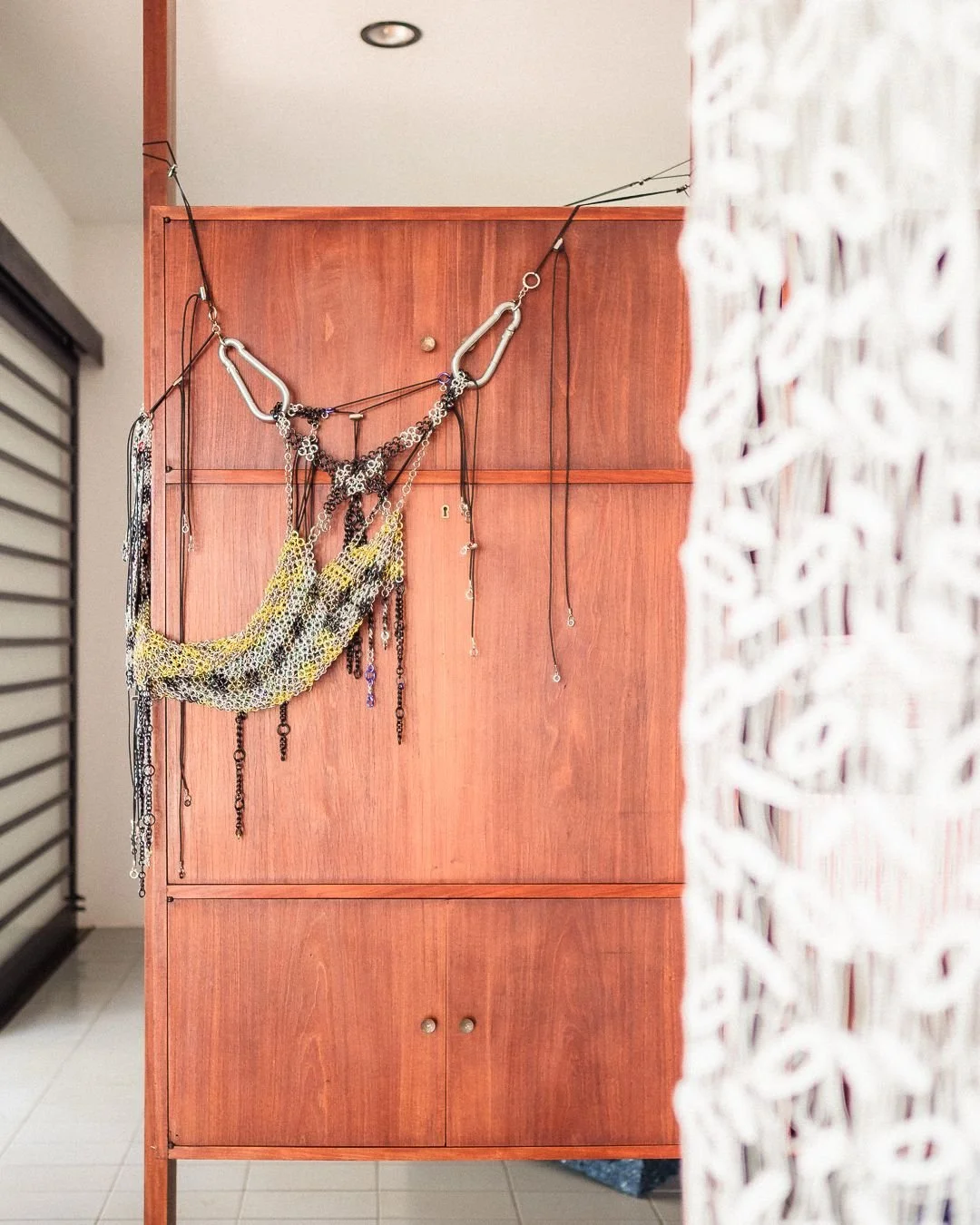
In the work of Alexandre dos Anjos, the body is central, traversed by spiritual, political, and performative dimensions manifested at the intersection of carnival and Afro-diasporic culture. Influenced by fashion, the artist articulates identity, magic, and allegory through a collage of materials such as metal, ceramics, leather, and embroidery, connecting the sacred to the earthly in works such as Serpente/Serafim (2021), while deepening ritualistic investigations in Costeiro Adjá – Oxum, Exú e Ogum (2024).
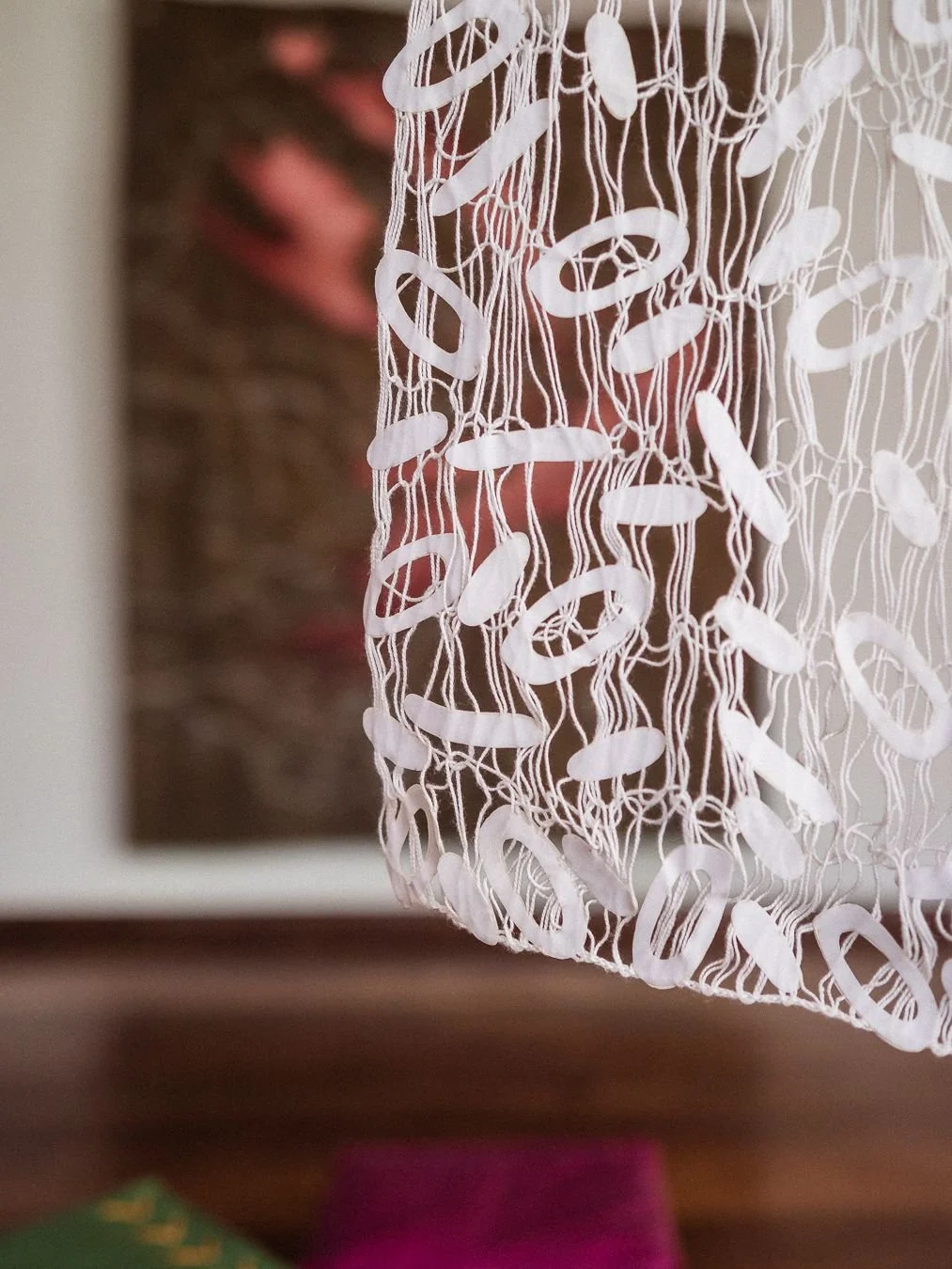
Carnival and Brazilian popular culture also permeate the practice of Jala, who, through a sculptural approach to the body, creates objects and installations that explore its magical and transformative potential. Using materials such as latex, tulle, and metals, and through garments, performances, and narratives, the artist constructs vibrant visual universes in which her adornments — marked by circular forms and multiple rings — establish new realities for the bodies that wear them. Textile practices serve as tools for narrative, resistance, and cultural continuity in contemporary art and visual culture.
André Azevedo is interested in the perception of the world through matter. By understanding an association between textile and text — an identification also made by Roland Barthes and Anni Albers — Azevedo investigates words plastically through their encounter with textiles. Through manual processes and the use of sewing and typewriting machines, as well as their components — such as ribbons and carbon paper — the artist creates works with abstract and figurative compositions in which weave and thread play a central role. In the Datilográfica series, for example, images are created through the repetition of typographic elements from the typewriter, painting the fabric’s weave. In the work Texto Têxtil (2026), presented in the exhibition, the artist replicates geometric forms and the words “text” and “textile,” creating an intriguing combination of image and visual poetry.
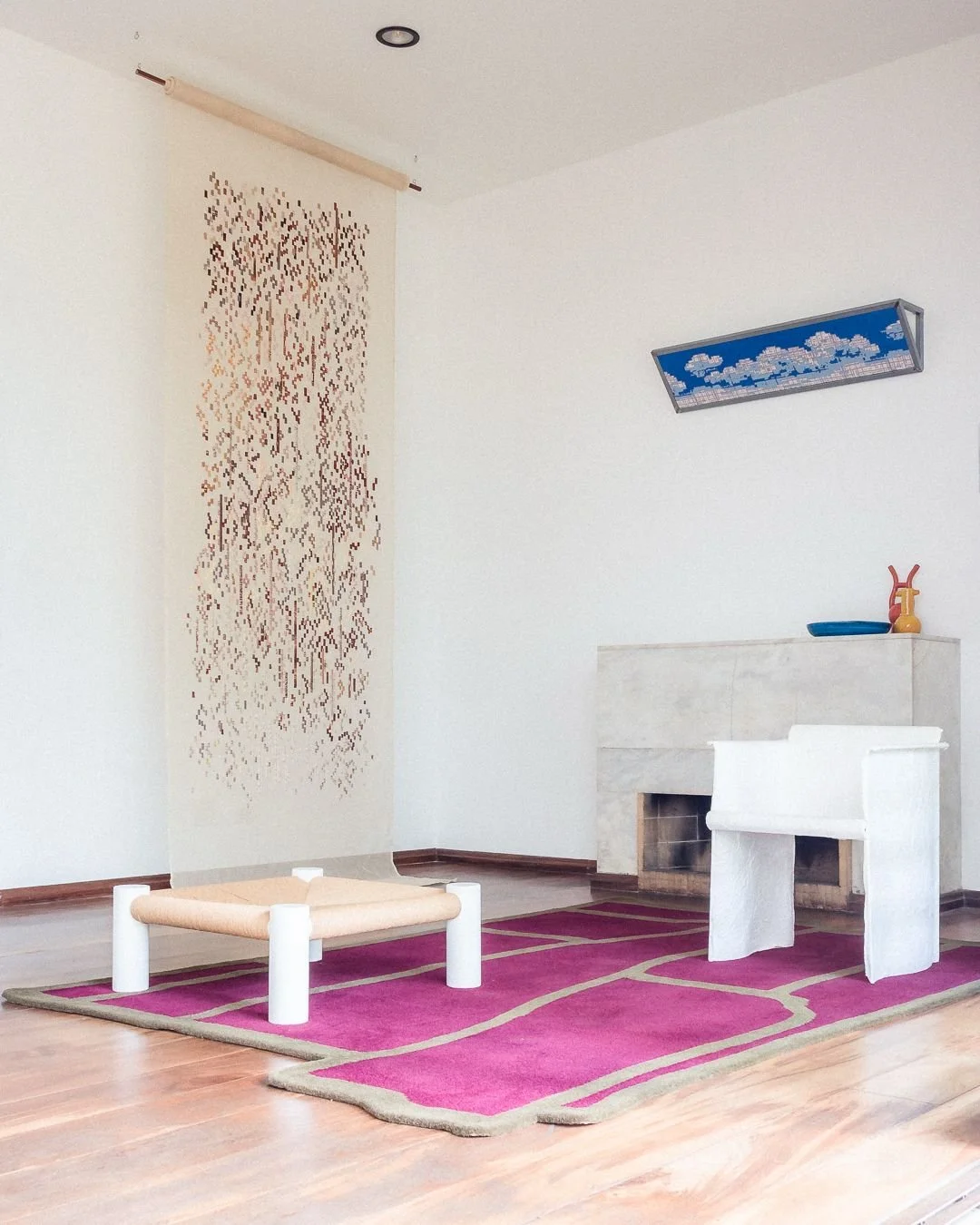
Repetition and graphic decoding through weave are also explored in the work of Fabiana Preti. Based on the structure of fabric and the relationships between fullness and emptiness in canvas mesh and mosquito netting, Preti develops geometric compositions in the Borboletário series. Inspired by butterfly colors, the artist creates graphic elements that repeat and combine across the surface, whose rhythm and composition evoke the sensation of the insects’ flight. In this series, the artist also works with different scales. While two of the exhibited works are medium-sized — allowing for a closer bodily connection through compositions featuring vibrant pinks as well as whites and creams — a third work draws attention through its spatial scale, extending from wall to floor and accentuating the movement of the graphic elements and the relationship between colors.
The structures and production processes of embroidery and tapestry also appear in the work of Gabriel Pessoto. Through objects and sculptures depicting everyday imagery — from domestic settings to natural landscapes — the artist combines digital and handcrafted techniques and visualities in order to reflect on the digitization of contemporary culture, memory, desire formation, and intimacy. Combining different media and temporalities, where handcrafted weave approaches the pixel, the works present images in an almost abstract figuration reminiscent of low-resolution digital imagery, exposing the process through which these images are constructed.
In Jardim (2024), three vertical sculptures resembling totems transport us to the recurring and familiar environment of tapestry within domestic space and its association with botanical motifs, vintage colors, and compositions. In Acessório 1/Handjob (2024), an object shaped like an oven mitt embroidered with kitchen motifs is tensioned by its title and the sexual connotation of the term “handjob.”
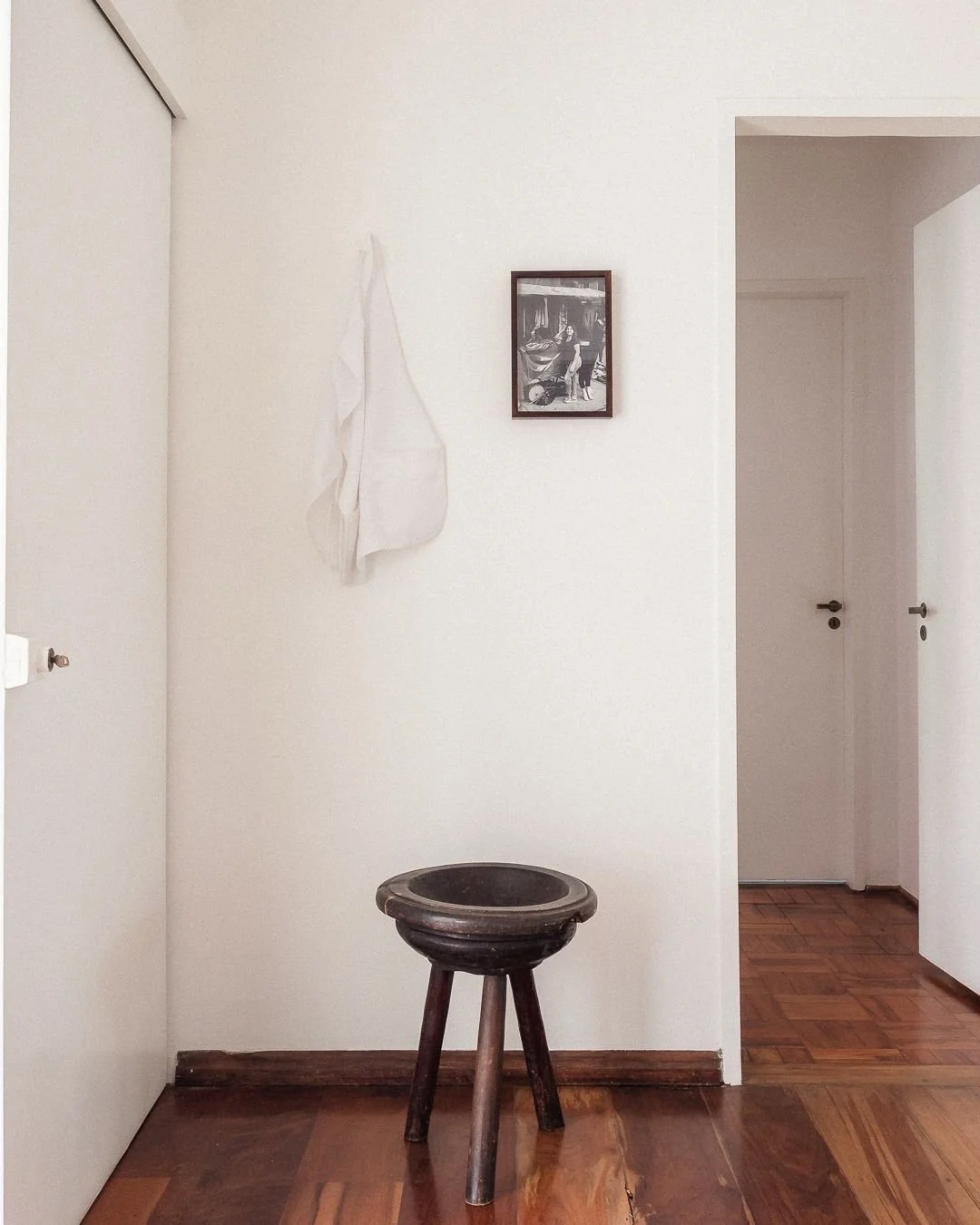
The photographs, objects, and installations of Cícero Costa fundamentally explore questions of memory through lived experiences and daily life, poetically composing his perspective on the city of São Paulo. His work also celebrates his family, especially his parents, a recurring subject in his practice. In the exhibition, Avental de trabalho da minha mãe (2019), an installation composed of his mother’s work apron hanging on the wall, is accompanied by a photograph of her selling clothes in Brás, São Paulo. Together, these works bring us to the center of questions surrounding identity, labor, care, and memory from a personal and affectionate perspective.
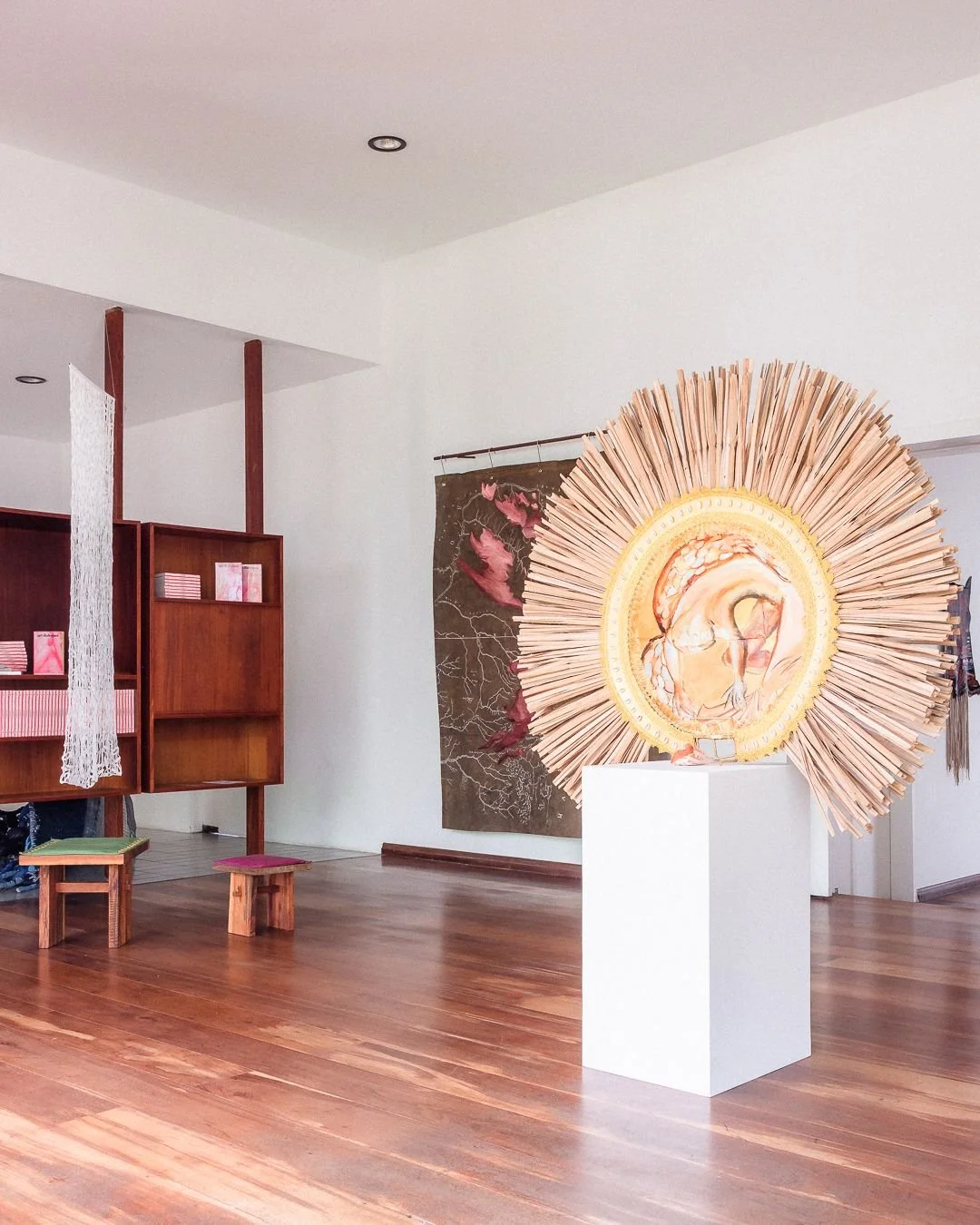
The work of Luiz Escañuela relates body, landscape, cartography, and politics. By bringing representations of territory closer to skin and viscera, the artist explores the topography of maps as though they were organs, granting them human materiality. Through analogies between body and geology applied to cartographic drawings, the artist creates works rich in textures and colors, such as pinks and reds. Elements in cold porcelain indicate the design and reliefs of this space, but above all reveal how the represented territory has been transformed by different people throughout history.
In Coreografia Encarnada da Capitania de S. Paulo, Escañuela uses a 1792 map and transforms it to indicate fundamental changes carried out by bandeirantes and muleteers that permanently marked the territory. The connection to memory and history is also present in the materials used, all of which are reused — including a ten-year-old tarp serving as the base for the work, as well as rebar and butcher hooks that support it.
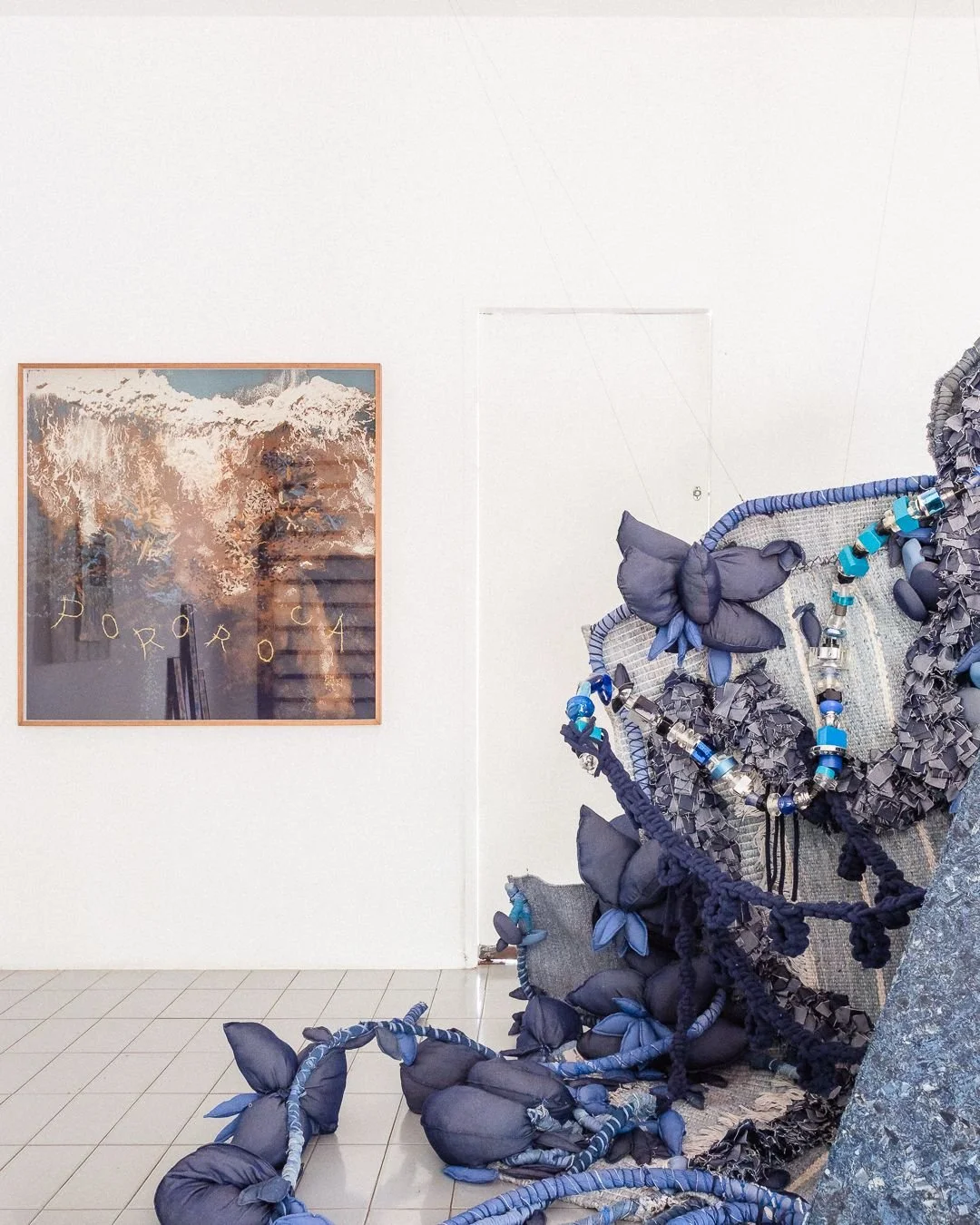
The natural landscape is also a source of inspiration for the knitted objects, rugs, blankets, and upholstered pieces by Paola Muller. Bringing her experience in fashion, the artist aligns design with the connection between body and space. In her works, she experiments with organic forms, colors, and textures that connect visual and tactile senses. In Pororoca (2025), created in collaboration with Taty Takasse, the artists evoke the strength and enchantment of the meeting between river and sea in this Amazonian natural phenomenon, reinforcing the movement of water and the relationship between blues and browns in the knitted base with hand-embroidered interventions.
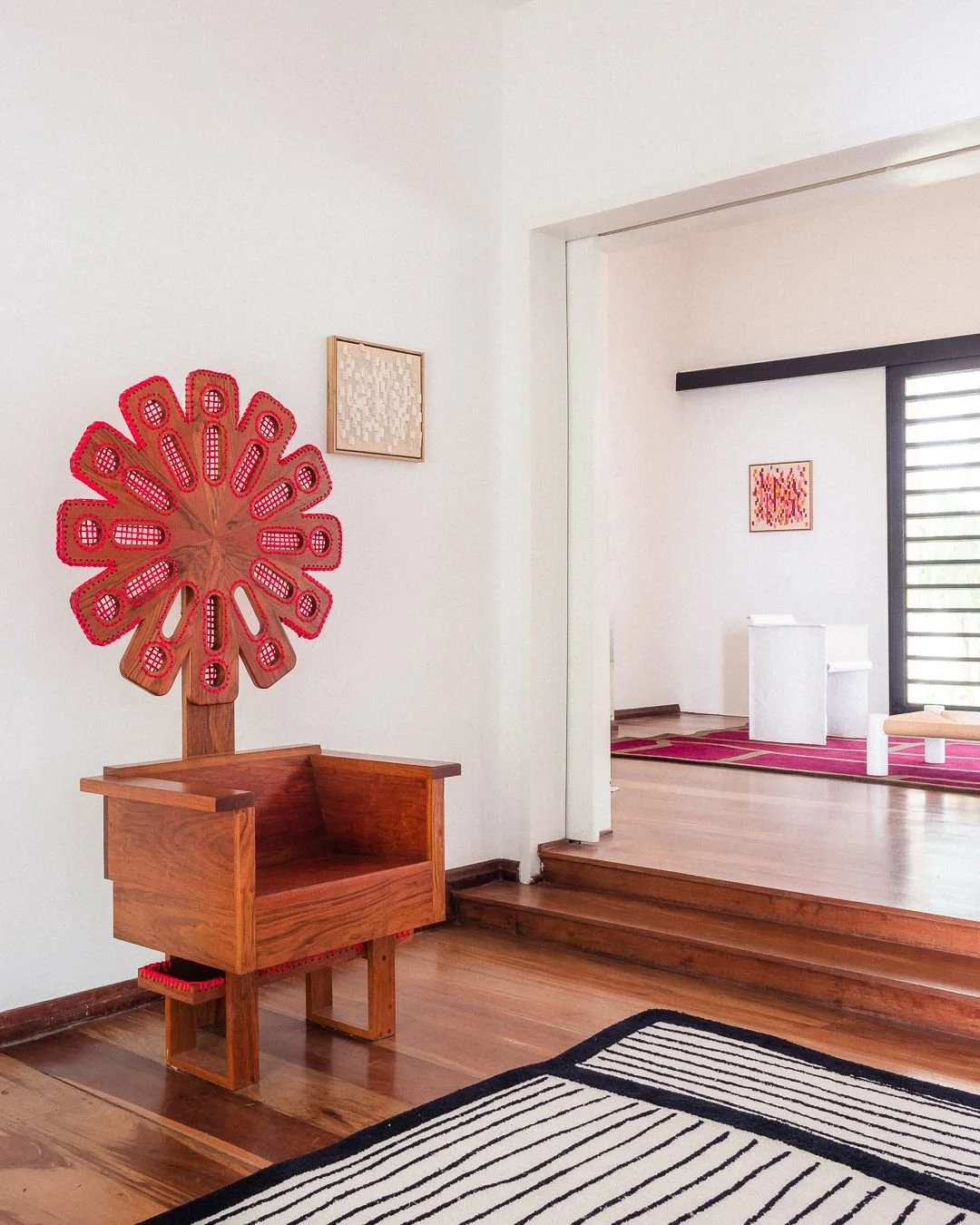
o elã da trama also includes furniture and objects that together compose the exhibition environments of Apartamento 61. The Guêra bench, for example, by the Pará-based studio Guá Arquitetura, has a structure produced by master artisans using wood rejected by the traditional industry, and a seat made by rubber-tapping women using natural latex and Amazonian cotton. The Naia chair, created in partnership between Guá Arquitetura and Pirilampos do Planeta, is made from textile industry waste such as denim, fabrics, and carpets.
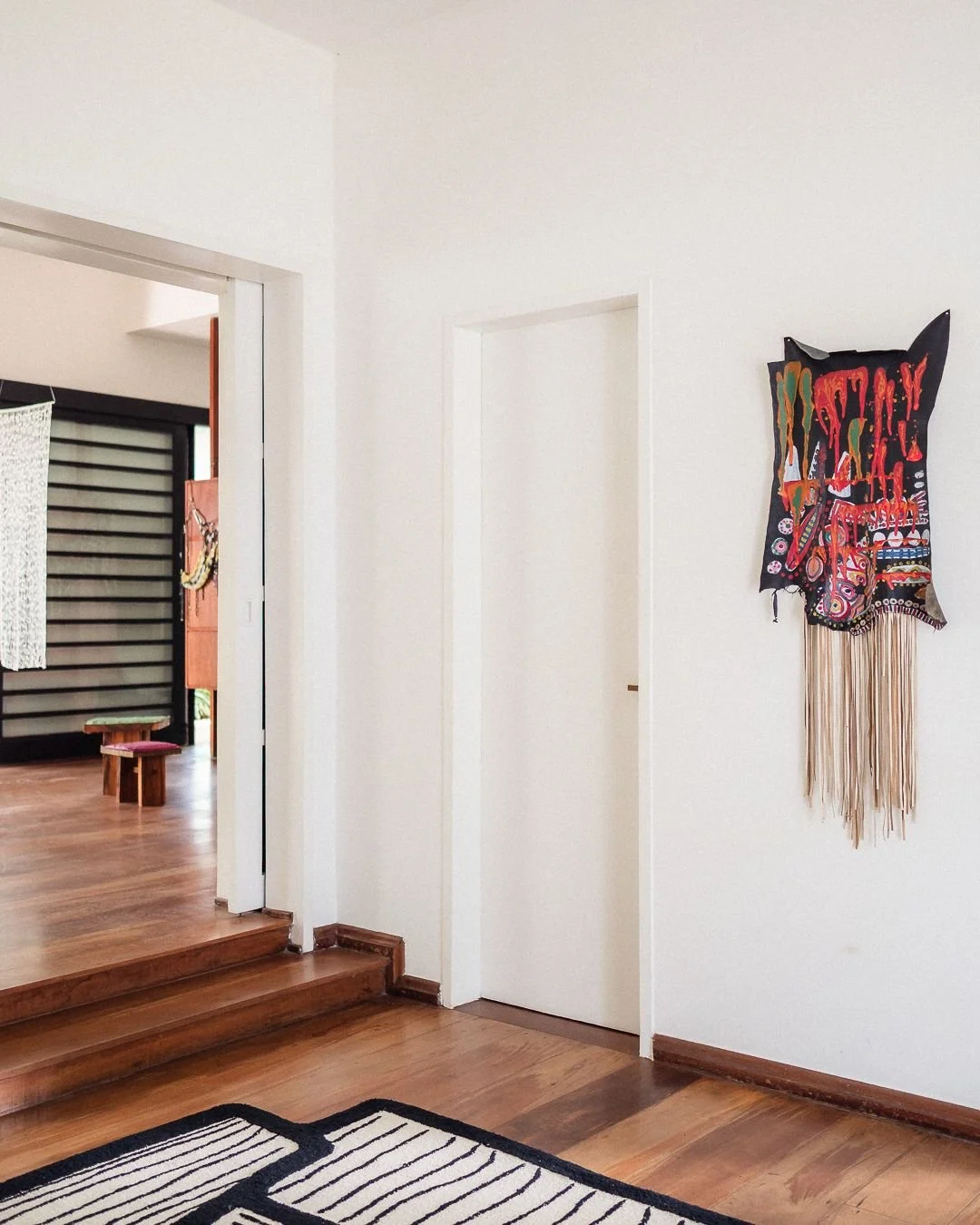
The exhibition articulates contemporary issues through the practices of artists and designers, evoking an interweaving with the environment through furniture and the insertion of life into everyday spaces. Textiles are embedded within the poetics of the ordinary, and the exhibition design reflects this thought, projecting itself beyond the white cube. o elã da trama inhabits a house in all its particularities and transforms the space into material weavings.
Text by Anita Goes, Mariane Beline, and Iara Pimenta (free translation)
Photos: André Azevedo