AMBITUDE
Fabiana Preti and Matías Malizia
Massapê Projetos
Curated by Ana Roman
April 5th, 2025 - April 12th, 2025
What surrounds us
I. Connections
In Ercilia, an imagined city created by Italo Calvino, relationships are marked by threads that cross corners, connect houses, and symbolize affections: “When the threads are so numerous that one can no longer pass among them, the inhabitants leave: the houses are dismantled, only the threads and their supports remain.” For Calvino, the city is built through these relations, woven like affective networks that become, simultaneously, visible and invisible. This image may be extended to other cities and ways of living collectively, in which interpersonal and social relationships constitute the true urban fabric, structuring our perception and our experience of occupied spaces. Human and spatial connections thus become bodily extensions, composed of memories and affections that sustain our existence. Such bonds are fragile and ephemeral by nature; they are continually subject to rupture and reconfiguration. After all, what remains of the city when there are no more relationships?
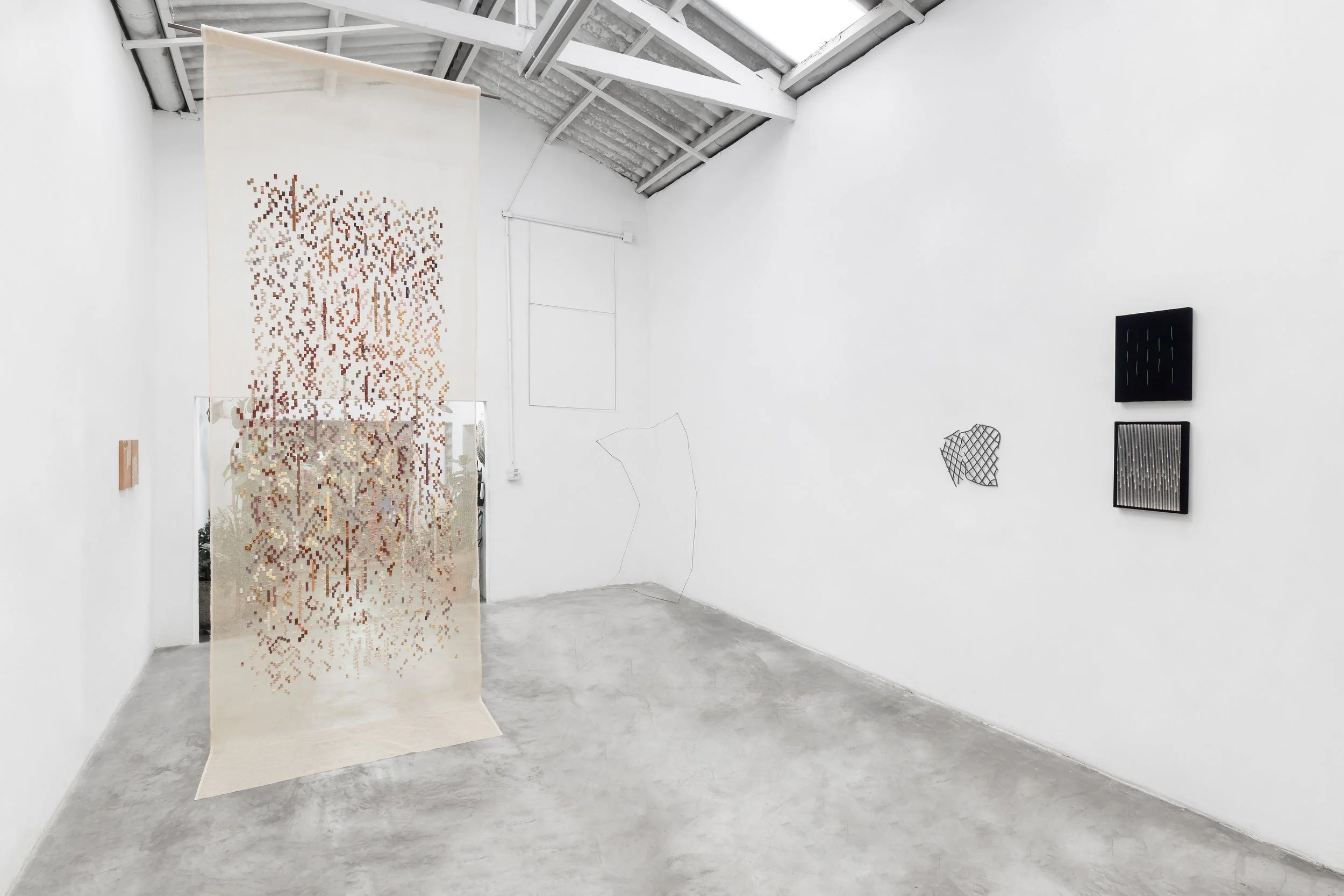
Matías Malizia’s works begin with an investigation into how bonds—so vital to urban life—may be reflected in artistic structures. Observing the city as a setting in constant mutation, he focuses on the delicate point between the visible and the invisible, the stable and the transient. Using magnets as architectural devices, the artist constructs structures that challenge the apparent rigidity of geometry. His installations are organized according to clear modular logics, yet the firmness of these designs proves illusory: there is always a latent fragility, a subtle threat of dissolution. Malizia works with materials that mutually support one another and conceives unstable geometries that operate strategically: they create space while exposing its impermanence, suggesting that all architecture is, in some way, transitory. The lines Malizia draws are provisional like the threads of Ercilia, ready to be abandoned or reconfigured as soon as new connections are established or undone.
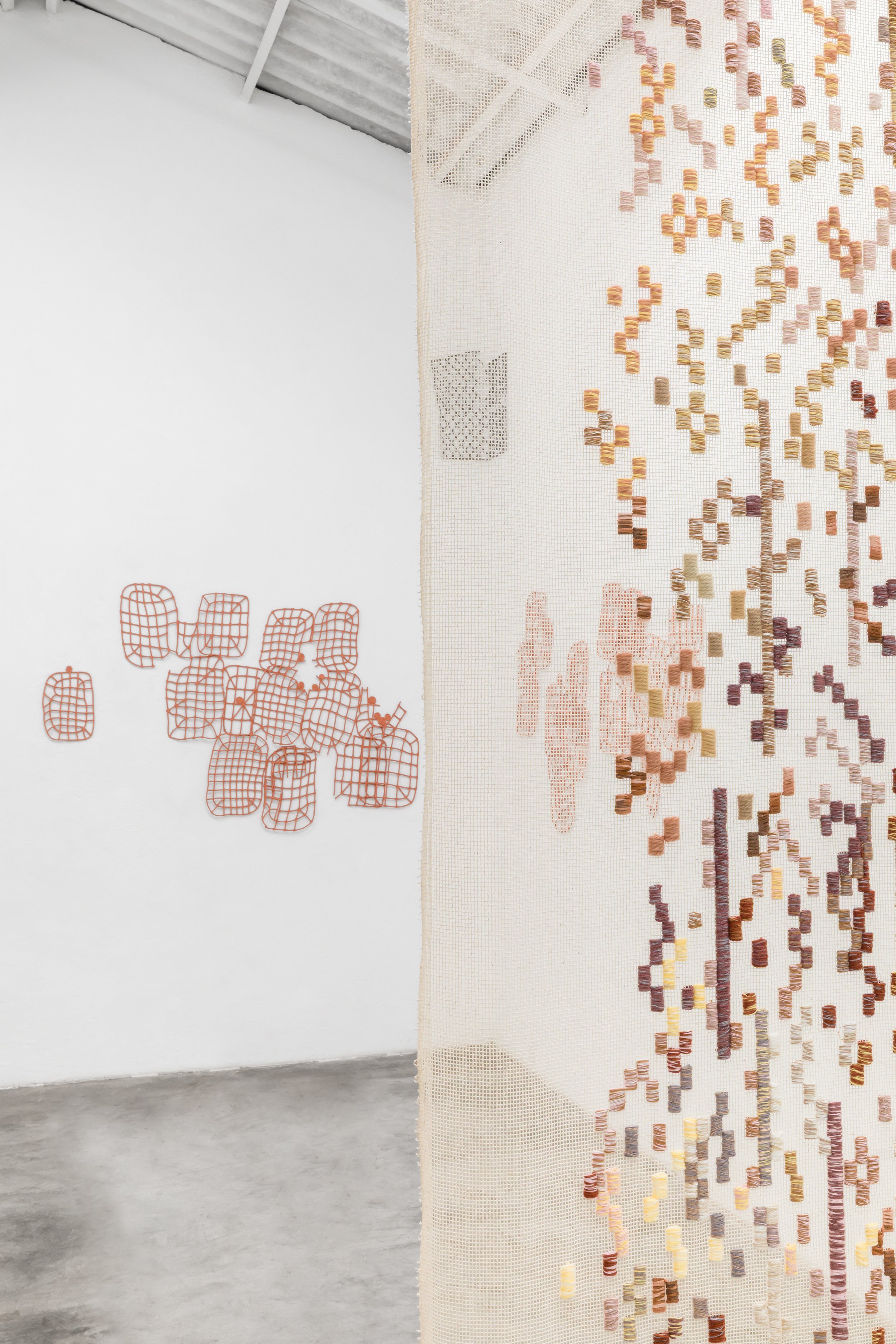
Recently, Malizia has devoted himself to ceramics and clay, materials that carry deep connections visible only under microscopic observation. These materials reveal complex networks of particles and interlinked elements, simultaneously strong and vulnerable, resistant yet brittle. In parallel, the artist investigates subterranean plant networks, exploring the complex vegetal communication that takes place invisibly beneath the soil. This research resonates with the concept of the infra-thin, developed by Marcel Duchamp in his notes. The infra-thin refers to nearly imperceptible events or sensations—subtle, fleeting experiences at the threshold of perception—such as the warmth left on a recently vacated seat or the unique scent that blends tobacco and breath. Duchamp described the infra-thin not as a noun but as an adjective, signaling a sensitive and ephemeral dimension of existence. For him, these minimal events gain importance precisely because of their delicacy and brevity, creating tenuous and singular connections between objects and people. As with Duchamp’s infra-thin, Malizia’s work emphasizes the power of the subtle and the temporary, revealing the silent intensity and importance of the most fragile and fleeting connections.
II. The incorpo
In O Atlas do Corpo e da Imaginação, Gonçalo M. Tavares reflects on the notion of the incorpo. The incorpo is understood as a network of bonds established between the individual and the world: positive or negative affections, habits, objects, spaces, animals, and memories. These connections give density and singularity to human existence, going beyond mere physical survival. By contrast, the body, in its most restricted dimension, would be only flesh, pure physiology, vulnerable matter that, without the incorpo’s connections, becomes easily relinquishable. To think the body, then, is to think its connections—the symbolic and affective networks that traverse, sustain, and define it.
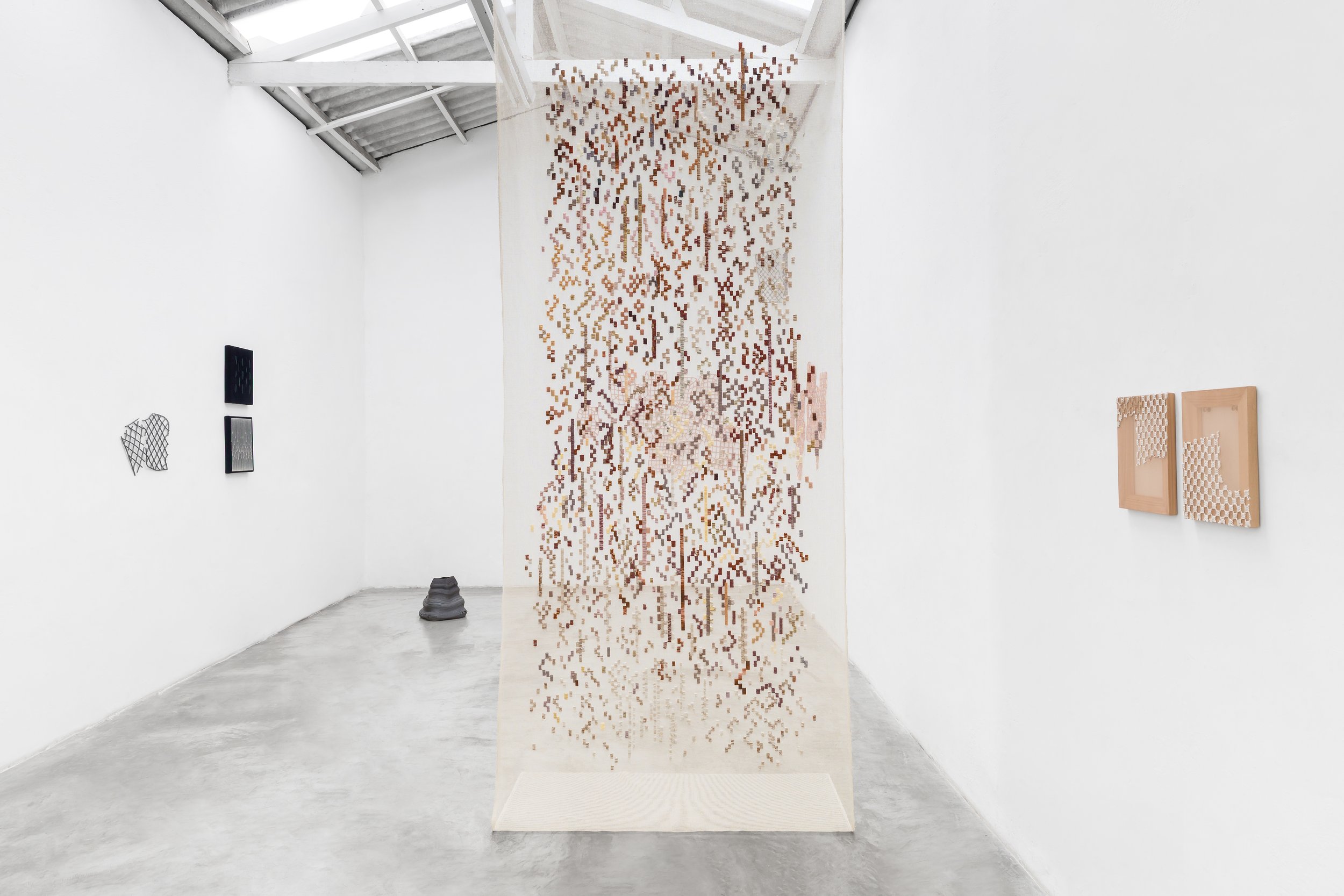
Fabiana Preti investigates form from this expanded idea of the body, exploring how affective and symbolic relations can structure our visual and material perception. Her research is marked by a constant search for geometry and abstraction: her works often begin with grids and geometric structures that, despite their apparent precision, display an unexpected malleability, questioning the limits between formal rigidity and the fluidity of matter.
Repetition emerges as a central resource in Preti’s work: while organizing the composition, it also creates opportunities for variation within seemingly uniform structures. This repetitive movement leads the viewer to notice subtle differences, approaching the idea of an “in-between space”—a place that connects and simultaneously distinguishes each element, preserving its singularity. In this sense, the “between” is not merely emptiness but a minimal line that touches and unites, sustaining a delicate balance. It is the meeting of distinct surfaces that neither cancel nor merge into one another, but reinforce each other through their differences. Color also plays an essential role, constructing visual dialogues that balance tension and harmony, intensifying the perception of relationships among diverse elements.
The precise geometry of the artist’s works is always crossed by the manual gesture, which leaves traces, flaws, and marks. In this sense, the line operates like a skin that touches and is touched, demarcating limits and dialogues between forms and materials. Fabrics and embroideries, for instance, reveal both processes and internal structures, highlighting equally front and reverse and emphasizing the duality between precision and imperfection, between concealing and revealing. Color, in turn, enhances this play, acting as a link that balances tension and harmony, opening new perceptual possibilities. In this way, Preti’s work achieves a synthesis in which geometric rigor and manual subtleties coexist.
III. Between orbits and ambits (or the cunning of tying the wind)
In astronomical terms, an orbit is the path a body traces under the gravitational influence of another. It generally takes an elliptical shape but may become extremely eccentric depending on the strength and alignment of the stars involved. Recently, astronomers discovered the exoplanet TIC 241249530 b, whose highly elongated orbit causes extreme temperature variations and suggests a possible transformation into a “hot Jupiter.” Located in a binary system about 1,100 light-years from Earth, the planet feels the pull of two misaligned stars. Its path is so eccentric that scientists compare it to a cucumber, such is its distortion. With each revolution, it undergoes intense fluctuations, as if trying to tie or lasso the wind—a gesture that evokes the attempt to contain, even momentarily, the unpredictable energy that drives it.
This orbital dance, with its abrupt transitions and thermal variations, may serve as a metaphor for how certain artistic practices deal with movement and uncertainty. To think of “lassoing the wind” does not mean freezing the uncontrollable, but capturing the moment when diverse forces converge and generate possibilities of form. The line that draws the orbit—now near, now distant—reflects a precarious balance, subject to sudden change.
For Malizia, the focus lies on constructing provisional geometries, in magnetic and ceramic compositions that remain joined only until a new configuration imposes change. His structures tie themselves together and come undone, like an orbit that shifts course with every external influence. Rather than stabilizing forever, the artist foregrounds impermanence as a fundamental element of urban space and the relationships established within it. Magnets, clay, and other fragile materials act as modular blocks that can be rearranged, in a constant choreography between construction and dissolution.
Fabiana Preti, meanwhile, turns to repetition and geometry, yet embraces delicate deviations that reinforce the affective and symbolic dimension of each mark. Her works, often based on grids and lines, become flexible through manual touch, chromatic nuance, and the sensitivity of embroidery or painting. Like the orbit of TIC 241249530 b, which loses and gains energy along its path, Preti’s production moves between intended order and the chance of flaws, displaying an internal dance that combines rhythm and improvisation. With each variation, new configurations emerge, as if the artist were always on the verge of releasing the wind that remains momentarily contained.
Between these unstable orbits, ambits also arise—not as fixed or enclosed zones, but as relational fields, fields of forces. If the orbit is a path influenced by gravity, the ambit is the provisional space formed by those influences. It is there that gestures are inscribed, materials settle (or resist), and objects gain time to exist before transforming. The works of Preti and Malizia do not restrict themselves to the physical space they occupy; they create their own ambits, opening zones of sensitivity and attention where form and instability coexist. Within these fields, containing the wind is not an act of domination but of listening—a way of remaining, for brief moments, in balance with what escapes. Like the exoplanet dancing between two misaligned stars, nothing here is permanently fixed: what remains is the cunning of capturing the moment of convergence—a fleeting orbit in which everything aligns—before the forces of time, space, or gesture provoke another metamorphosis.
Text by Ana Roman (free translation)
Photos: Estúdio em obra